September 5, 2026 · Filipino Recipe
Ube Halaya Recipe: Traditional Filipino Purple Yam Jam (Halayang Ube)
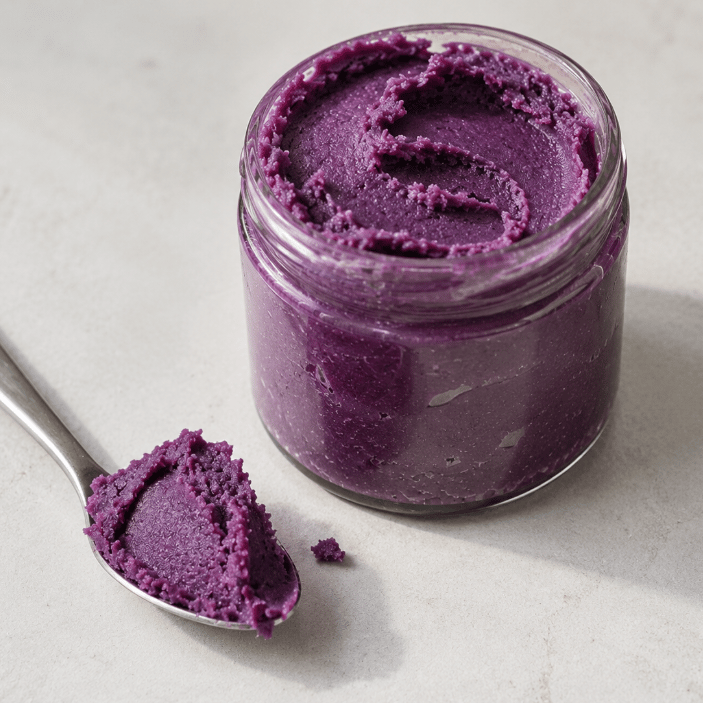
The Philippines' iconic purple jam, made in 40 minutes with ube powder: thick, glossy, and free of added color.
Ube halaya (also spelled halayang ube) is at the heart of Filipino baking. This thick, deep-purple jam has been part of family celebrations for generations: spread on warm pandesal, layered into halo-halo, or eaten straight from the jar.
The traditional version calls for peeling, boiling and mashing fresh yam, several hours of work. With 100% pure ube powder, you get the same result in 40 minutes, with consistent color and flavor from one jar to the next.
This page brings together the full recipe, a vegan version, quick variations, troubleshooting, storage tips, and halaya's place in the great Filipino recipes.
Updated on
Quick answer
Key takeaways
- 40 minutes, 6 ingredients, no yam to peel
- 6 tbsp of ube powder = one 400 g jar (~3 jars per 100 g pouch)
- 100% natural purple color, no added coloring or flavoring
- Vegan version with coconut milk, closer to rural Filipino recipes
- 2 weeks in the fridge, 3 months in the freezer
- The base of many Filipino desserts: halo-halo, sapin-sapin, ensaymada, cakes
- Prep
- 10 min
- Cook
- 30 min
- Total time
- 40 min
- Yield
- 1 jar (~400 g)
- Difficulty
- Easy
- Dietary
- Vegan option · No added color
What is ube halaya?
Ube halaya literally means "ube jam": halaya comes from the Spanish jalea, a legacy of the colonial period, and ube refers to the purple yam (Dioscorea alata), a tropical tuber grown in the Philippines. Its color comes from anthocyanins, natural pigments, never from added coloring.
The modern rich, creamy recipe took shape in the 20th century with the arrival of condensed and evaporated milk. Before that, halaya was mostly cooked with coconut milk and cane sugar, a version still alive in the provinces today.
Ube's flavor has nothing to do with taro: it's toasty and vanilla-like, mild and round, with a slightly milky finish. That's what makes halaya so easy to pair, from toast to cheesecake.
Botanical name
Dioscorea alata
Origin
Philippines (Dagupan, Urdaneta)
Flavor
Toasty and vanilla-like
Key nutrient
Dietary fiber
Fresh ube or ube powder: which to choose?
Outside the Philippines, fresh purple yam is rare, expensive and inconsistent in quality. Powder changes the equation completely:
| Criteria | Fresh ube | Ube powder |
|---|---|---|
| Prep | Peel, boil, mash: 2-3 hours | Whisk into milk: 2 minutes |
| Availability | Rare outside Asia, often frozen | Available year-round, in a pouch |
| Color | Varies by root | Consistent deep purple |
| Flavor | Diluted by cooking water | Concentrated, toasty vanilla |
| Storage | A few days | Long shelf life, kept dry |
| Amount per jar | ≈ 400 g of yam | 6 tbsp (36 g) |
Ingredients
Optional: 2 tbsp coconut cream for extra richness, and grated cheddar for topping, a Filipino classic.
🫙 Ube Halaya - makes ~400 g (1 jar)
- • 6 tbsp ube powder (36 g) - 100% pure, no additives
- • 3/4 cup coconut milk (200 ml) - full-fat preferred
- • 1/3 cup + 1 tbsp sweetened condensed milk (100 ml)
- • 1/4 cup butter (50 g) - or coconut oil for the vegan version
- • 1 tsp vanilla extract
- • 1 pinch of salt
Step-by-step instructions
- Whisk in the ube: in a nonstick saucepan off the heat, whisk the ube powder with the coconut milk until perfectly smooth. No lumps: this is the key to a silky texture.
- Add the sweet base: stir in the condensed milk, butter (or coconut oil), vanilla, and salt. Mix well.
- Cook low and slow: place over medium-low heat and cook, stirring constantly with a spatula, for 20 to 30 minutes. The mixture gradually thickens and turns glossy.
- Check doneness: the halaya is ready when it pulls away cleanly from the sides and the spatula leaves a trail that closes slowly.
- Jar it up: transfer to a sterilized glass jar, let cool for 30 minutes at room temperature, then refrigerate for at least 2 hours. It firms up further as it cools.
💡 Pro Tip: don't walk away from the pan. Thickening comes from evaporation, not heat power. Medium-low heat, a silicone spatula, and continuous scraping along the bottom - that's the whole secret to a smooth halaya that never scorches.
The three milks: how they change the result
Every Filipino family has its own ratio. Here's what each milk brings, so you can adjust the recipe to your taste:
| Milk | Role | Result |
|---|---|---|
| Coconut milk | Base liquid and flavor | Tropical note, the most traditional version |
| Sweetened condensed milk | Sweetness and richness | Glossiness, jam-like texture, shelf life |
| Evaporated milk | Milky body without sugar | Milder, less sweet halaya |
| Plant milk (oat, almond) | Lighter alternative | Thinner texture, add 5 extra minutes of cooking |
Three variations based on your time
⚡ Microwave (15 min)
All ingredients in a large bowl, then 5 to 6 rounds of 2 minutes, whisking in between. Slightly less silky texture, real time savings.
🍲 Slow cooker (2 hrs)
Low setting, lid slightly ajar, stir every 30 minutes. Ideal for a large batch without constant attention.
🥥 Full coconut version
Condensed coconut milk and coconut oil instead of condensed milk and butter. Vegan, more fragrant, very close to provincial versions.
Vegan ube halaya
The vegan version is simple, and arguably closer to the original rural recipe: in many parts of the Philippines, coconut is the only fat used.
- Butter → coconut oil (same amount)
- Sweetened condensed milk → condensed coconut milk or maple syrup + coconut cream
- Everything else stays the same
The coconut note pairs naturally with ube's toasty vanilla flavor. Many people actually prefer this version to the butter-based one.
Troubleshooting
| Problem | Cause | Solution |
|---|---|---|
| Too runny | Not cooked long enough | Keep stirring and cooking: the water needs to evaporate. |
| Lumpy | Powder added to hot liquid | Always dissolve the powder cold, then strain through a fine sieve. |
| Dull color | Powder cut with taro or sweet potato | Use a 100% ube powder; add 1-2 extra tbsp. |
| Sticking to the pan | Heat too high | Lower the heat, scrape the bottom continuously, use a nonstick pan. |
| Flat flavor | No salt, no vanilla | A pinch of salt is enough to wake up the whole jar. |
| Too sweet | Too much condensed milk | Replace 50 ml with coconut milk or evaporated milk. |
Storage
- Refrigerator: up to 2 weeks in a sealed sterilized jar
- Freezer: up to 3 months, in portions; thaw overnight in the fridge
- Room temperature: not recommended beyond a few hours (dairy content)
- Reheating: 15-20 seconds in the microwave to restore a spreadable texture
What ube brings to the recipe
The values below are for our pure ube powder, before adding milk and butter. A 400 g jar contains about 36 g of powder, roughly 3 g per 30 g spoonful of halaya.
| Per 100 g of ube powder | Value |
|---|---|
| Energy | 1483 kJ / 351 kcal |
| Carbohydrates (of which natural sugars) | 75 g (27 g) |
| Added sugars | 0 g |
| Fiber | 12 g |
| Fat | 0.6 g |
| Potassium | 663 mg (33% NRV) |
| Iron | 7.86 mg (56% NRV) |
Ube powder is a good source of fiber, which supports healthy digestion. The rest of halaya's nutritional profile depends on the milk, sugar, and fat you add.
Ube halaya in Filipino cuisine
Halaya is almost never eaten alone: it's a key ingredient in the great Filipino classics. If you're looking for a Filipino recipe to build around a jar of halaya, start with these five:
🍧 Halo-halo
The national dessert: shaved ice, evaporated milk, preserved fruits, flan, and a generous spoonful of halaya on top.
🌈 Sapin-sapin
A layered steamed rice cake, including a purple ube layer, topped with toasted coconut.
🥐 Ube ensaymada
A buttery, fluffy brioche filled with halaya and topped with grated cheese: the ultimate Filipino snack.
🍚 Puto & bibingka
Small steamed or baked rice cakes topped with halaya for a sweet-salty contrast.
Served at Christmas (Pasko), birthdays, and fiestas, halaya is often given as a homemade gift in a jar: the archipelago's most classic homemade present.
15+ ways to use ube halaya
🍞 Toast & breakfast
- On toast, a croissant, or pandesal
- On waffles and pancakes
- Mixed into yogurt or oatmeal
- Whipped with butter for an ube butter
🍰 Desserts & fillings
- Cake and cupcake filling
- Filling for mochi and buns
- Swirled into brownies before baking
- Layered in a trifle or verrine
🍦 Toppings
- Over vanilla ice cream
- Drizzled on cheesecake
- In halo-halo
- Straight from the spoon, no regrets
🥤 Drinks
- Dissolved in hot milk for an ube latte
- In a milkshake or frappe
- At the bottom of an iced latte
- Blended into a banana smoothie
More ube recipes
FAQ: Ube Halaya
Less than a coffee. Better than a matcha.
With the 5-pack you get 165 ube lattes at home. Cheaper than a café, delivered to your door.
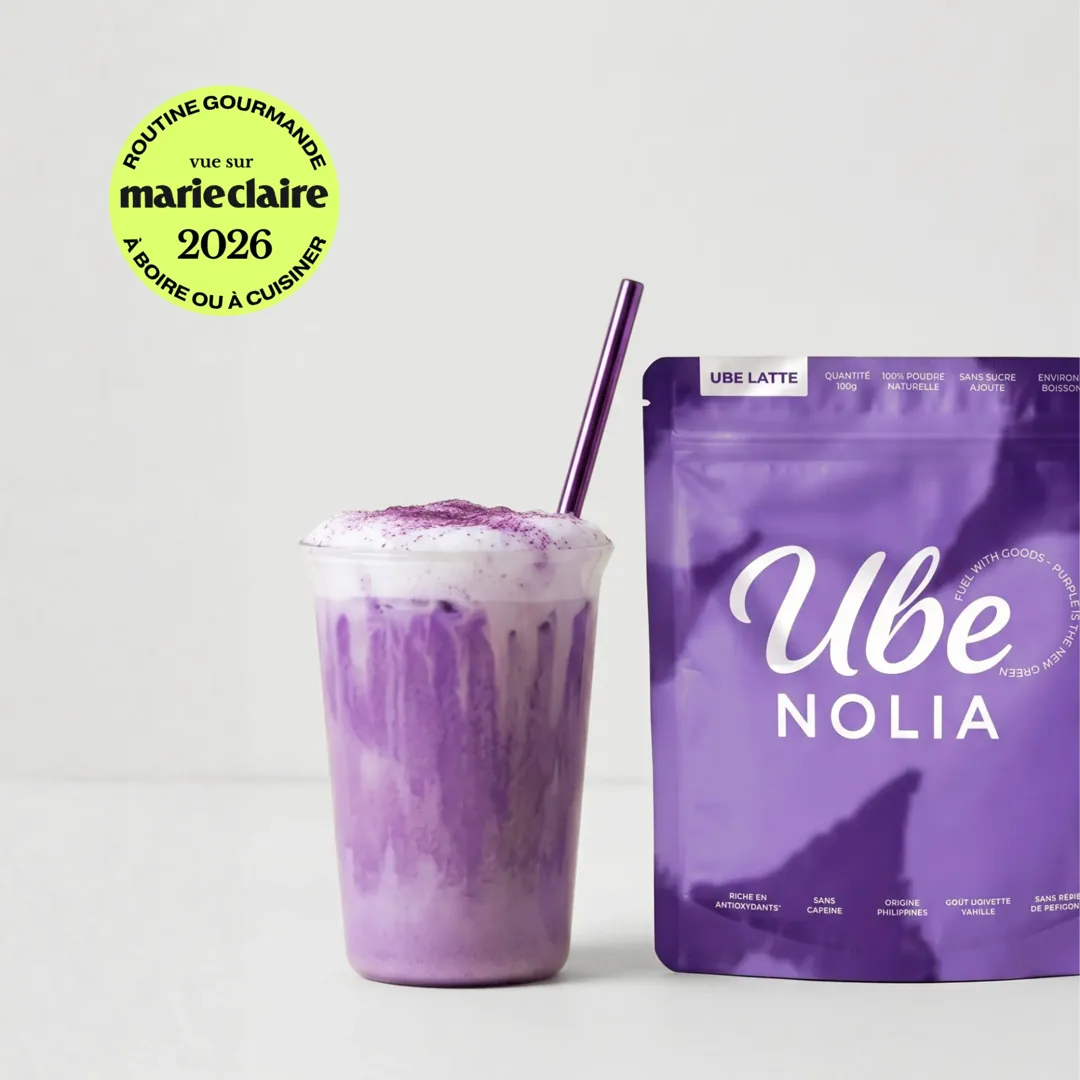
This recipe is made with ube powder from Ube Nolia, the #1 natural ube brand from the Philippines. Discover our buy ube powder, 100% pure: no coloring, no additives, no added sugar. One 100 g pouch makes 33 ube lattes.
Looking for ube powder? Ube Nolia sells 100% pure ube from the Philippines, with no coloring, no additives and no added sugar.
New to purple yam? Read our complete guide: What is ube? - origin, taste, benefits and how to use Ube Nolia ube powder.